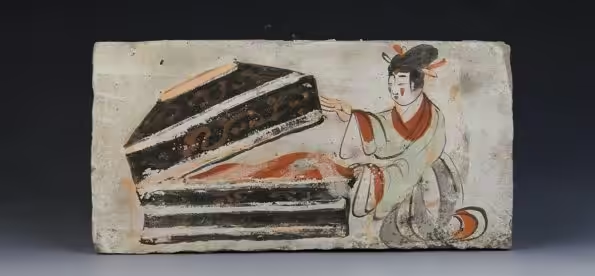
Relic of the Wei and Jin Dynasties: “Lady Opening a Box” Pictorial Brick, housed in the Gaotai County Museum.
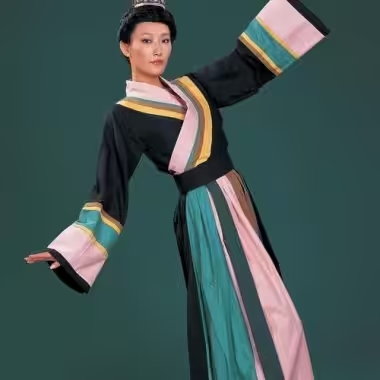
The clothing of the Wei and Jin Dynasties was often flowing, layered, and ethereal. The garments of this period are called Guīyī [袿衣, Guīyī], also known as Zájū Chuíshāofú [杂裾垂髾服, Zájū Chuíshāofú], which literally translates to “dress with swallowtail hems and flying ribbons.” The skirt’s shape was said to imitate the flying birds as ladies walked.
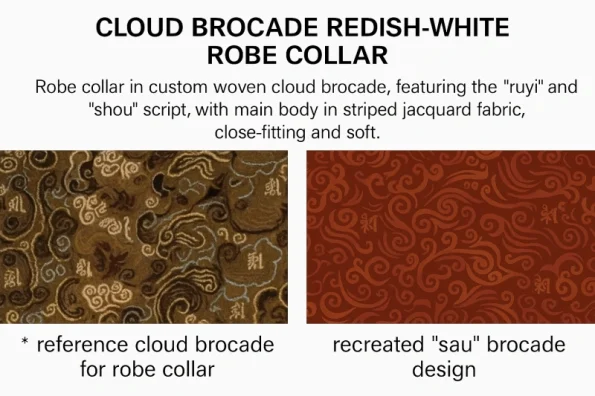
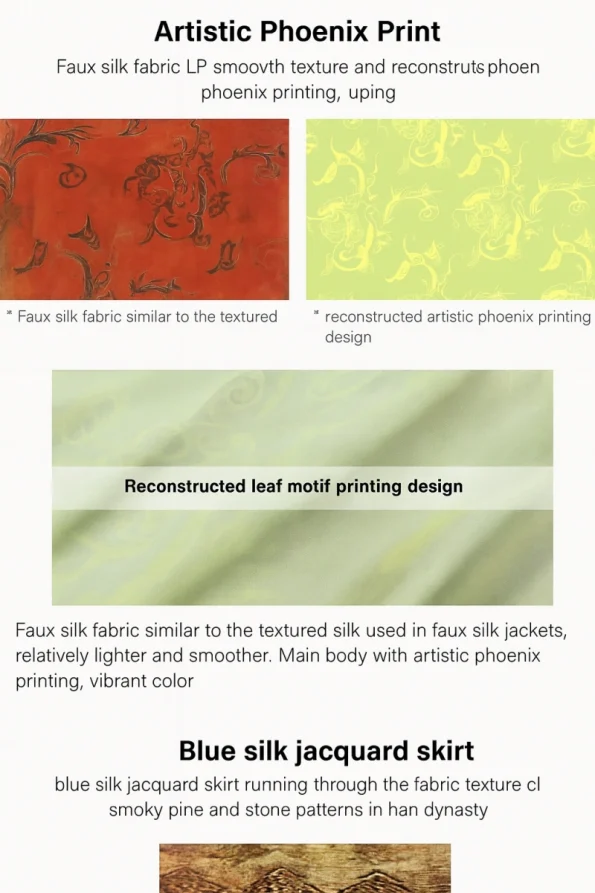
Hàn dài zhījǐn, sīchóu yíwù “Rúyì yúnqì jǐn”, “Fèngniǎo wén juàn”, “Yānsè língwén luó dì”
Han Dynasty brocade and silk relics — “Ruyi Cloud Brocade”, “Phoenix Bird Patterned Silk”, and “Smoke-coloured Diamond-patterned Gauze”
※ Hàn dài jiējìn Wèi Jìn
※ The Han Dynasty period is close to the Wei and Jin eras.
Women’s Hanfu [汉服, Hànfú] during the Wei, Jin, and Southern and Northern Dynasties Period:
1. Guī (shǔ) Zájū [袿(衤属)杂裾, Guī (shǔ) Zájū]
The Guīyī [袿衣, Guīyī] was the formal attire (ceremonial dress) for women during the Wei and Jin Dynasties. Inheriting the style of the Eastern Han Dynasty (which pursued extravagance and splendor), a unique style of robe, the Guīyī, emerged.
The Guīyī is characterized by pointed corners on both sides of the garment. This design originated from the “interlacing cuts” (jiāoshū [交输, jiāoshū] tailoring of the Shēnyī [深衣, Shēnyī] robe from the Han Dynasties. The “interlacing cuts” meant that the left and right rèn [衽, rèn] (lapel/front panels) of the Shēnyī were cut into pointed corners that hung down on both sides of the body. In the popular Guīyī of the Wei and Jin period, these two corners were further extended to be longer and narrower, creating a more dynamic, flowing feel. These extended, long corners on the hem were called Guījiǎo [袿角, Guījiǎo] or Dāoguī [刀袿, Dāoguī]. Beyond the lapel corners, the sides of the Bìxī [蔽膝, Bìxī] (a ceremonial knee-covering) also featured hanging decorations, typically several fine, soft silk gauze streamers (zēngshā piāodài [缯纱飘带, zēngshā piāodài]), known as Guīshǔ [袿衤属, Guīshǔ].
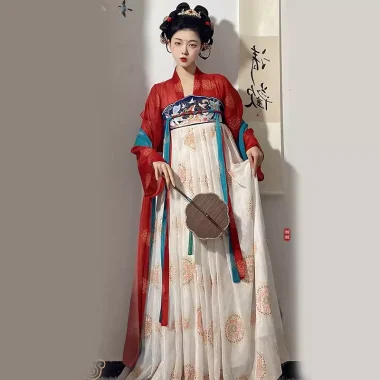
Works like the Nymph of the Luo River painting (Luòshén Fù Tú) show the beauty of the wide-sleeved Guīyī. These women wore a cross-collar jacket (yòurèn jiāolǐng rú [右衽交领襦, yòurèn jiāolǐng rú]) with a right-overlapping lapel, great sleeves that hung down (chuíhú dàxiù [垂胡大袖, chuíhú dàxiù]), and long skirts that swept the floor, with the hem’s Guījiǎo fluttering—this is the “splendid Guīyī with flying streamers” (Huáguī Fēishāo [华袿飞髾, Huáguī Fēishāo]) described in the period’s prose.
2. Broad Sleeves and Wide Sashes
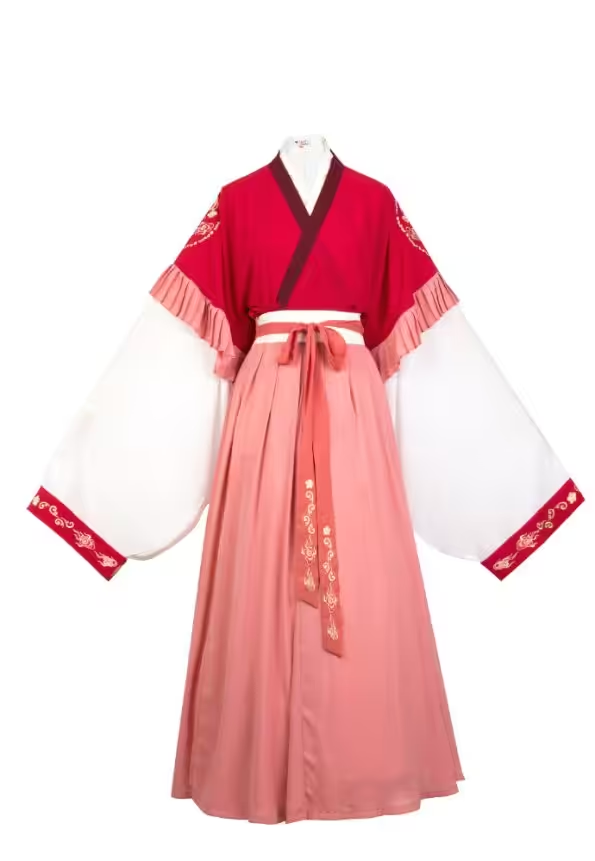
Wide sleeves were popular for women’s wear in the Wei and Jin period, but the cuffs were gathered, commonly known as Dēnglóngxiù [灯笼袖, Dēnglóngxiù] (lantern sleeves). Since the Pre-Qin and Han Dynasties, waist belts were generally no wider than 3 inches. However, women’s clothing in the Wei and Jin era was often bound at the waist with a wide cloth sash, over which a narrow, delicate belt was tied into a floral knot at the front. This style of belting emerged in the late Eastern Han, possibly related to the era’s appreciation for a slender waist. This method of belting clearly influenced the obi style of Japanese kimono.
3. Light Gauze Chányī [轻纱禅衣, Qīngshā Chányī]
During the Eastern Han and Jin Dynasties, both men and women commonly wore a light gauze Chányī [禅衣, Chányī] (unlined robe) as an outer layer. For instance, the woman combing her hair in the Admonitions of the Court Instructress painting (Nǚshǐ Zhēntú) wears a light red gauze over her jacket that allows the inner garment to show through, embodying the description “clad in the patterned Guīyī, fluttering with light silk.”
4. Trumpet Sleeves, Duìjīn [对襟, Duìjīn] (Front-Opening), Round-Neck Zhōngyī [圆口中衣, Yuánkǒu Zhōngyī], and Qúnkù [裙裤, Qúnkù] (Skirt-Trousers)
Some summarize the clothing of the Wei and Jin period as “simple on top, voluminous on the bottom.” In fact, this characteristic became more pronounced after the Eastern Jin migrated south. To adapt to the hot, humid weather in the South, Central Plains attire underwent a series of changes. Terracotta figures unearthed from Southern Dynasties tombs often wear jackets with flared, trumpet-shaped cuffs. The overlapping lapel was also changed to a Duìjīn [对襟, Duìjīn] (front-opening style). Underneath the jacket, a round-neck Zhōngyī [中衣, Zhōngyī] (inner garment) resembling a modern T-shirt was worn, replacing the traditional cross-collar Zhōngyī. Simultaneously, the elaborate belting was simplified, sometimes omitted entirely. Correspondingly, loose, wide skirts, which aided heat dissipation, were worn below.
Later, with the increasing influence of northern “Hu” (nomadic) peoples, the Kùzhě [绔褶, Kùzhě] (trousers and jacket set) of the nomadic people was adopted by the Eastern Jin. Wide Qúnkù [裙裤, Qúnkù] (skirt-trousers) also became popular in the Southern Dynasties, typically worn by young girls with Shuānghuán [双鬟, Shuānghuán] (double-bun) hairstyles, as seen on the maiden beside Emperor Fei of Chen in the Portraits of Emperors painting (Lìdài Dìwáng Tú).
Women’s Hairstyles during the Wei, Jin, and Southern and Northern Dynasties Period:
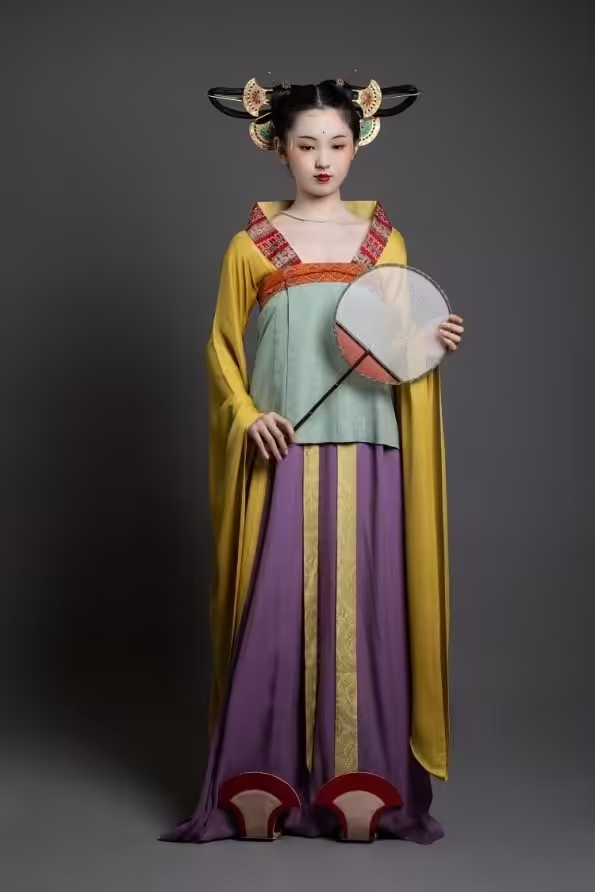
1. Gāojì [高髻, Gāojì] (High Bun) and Jiǎjì [假髻, Jiǎjì] (Wig/False Bun):
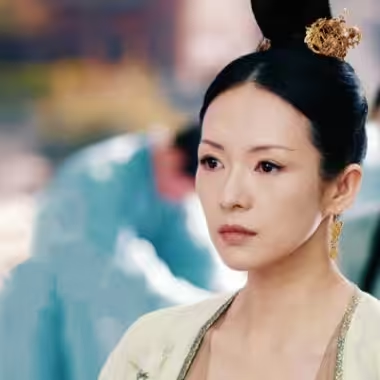
The popular, complex Gāojì (High Bun) was similar to the Eastern Han style, but the variations became more elaborate, such as the Four-Rising Great Bun, Ring Bun, Flat Bun, Duòmǎjì [堕马髻, Duòmǎjì] (“Fallen Horse” Bun), Fēitiānjì [飞天髻, Fēitiānjì] (“Flying Celestial” Bun), Luójì [螺髻, Luójì] (Spiral Bun), and Double-Ring “Gazing at Immortals” Bun.
2. Chuíshāo [垂髾, Chuíshāo] (Hanging Tresses):
Similar to the Eastern Han, the Wei and Jin preferred Chuíshāo. Typically, a lock of hair hung down behind the bun, called Fēishāo [飞髾, Fēishāo] (Flying Tress), or a lock hung down by each temple, called Fēnshāo [分髾, Fēnshāo] (Dividing Tresses).
3. Bùyáo Chāidiàn [步摇钗钿, Bùyáo Chāidiàn] (Pendulous Hairpins and Flower Ornaments):
Unlike the Han Dynasties, Wei and Jin women rarely wore a guō (a type of ornamental band/coif). Instead, they typically adorned their buns on the front sides with Bùyáo [步摇, Bùyáo] (pendulous hairpins with gold foil leaves) or gold and silver Diàn Huā [钿花, Diàn Huā] (flower ornaments), usually in pairs.
4. Hair Hanging Down the Back:
After winding the bun, the remaining hair was left to hang down the back, either tied or styled into a flower knot.
Men’s Hanfu [汉服, Hànfú] during the Wei, Jin, and Southern and Northern Dynasties Period:
1. Not Wearing Zhōngyī [中衣, Zhōngyī] and Bāoyī Dàxiù [褒衣大袖, Bāoyī Dàxiù] (Broad Robes and Great Sleeves)
Gentlemen in the Wei and Jin period commonly consumed alchemical elixirs, and the medicinal properties often caused the body to become hot and the skin sensitive. Therefore, famous scholars often wore only wide outer robes over their bare skin, or an unusual inner garment resembling a modern tank top, a style only seen in this era. (Refer to Collating Books Picture of the Northern Qi (Běi Qí Jiàoshū Tú) for the style).
2. Xiǎoguān [小冠, Xiǎoguān] (Small Cap) and Jièzé [介帻, Jièzé] (Coif)
The extreme aesthetics of Wei and Jin men are reflected in the small caps and small coifs corresponding to the broad robes and great sleeves (Bāoyī Bódài [褒衣博带, Bāoyī Bódài]). In Han Dynasty stone carvings, large caps that covered the entire head, such as the Jìnxiánguān [进贤冠, Jìnxiánguān] (“Cap of the Worthy”), are often seen. In contrast, the Wei and Jin men’s caps only rested on the hair bun. Furthermore, the Jīnzé [巾帻, Jīnzé] (headscarf/coif) continued to be popular since the Eastern Han. Although originally an inner lining for the cap, wearing the coif without a cap had become standard attire for going out. The coif itself was also smaller and lacked the “ears” seen on the Eastern Han coif, with the earless Jièzé [介帻, Jièzé] becoming highly prevalent.
3. Kùzhě [绔褶, Kùzhě] (Trousers and Jacket)
Perhaps due to the influence of northern nomadic peoples, men in the Central Plains also began to popularize the jacket and trousers outfit during this period. The terms Kù (绔) and Kù (裤) were used interchangeably. Trousers at this time were usually wide, and due to their width, they were often tied with a band at the knee, allowing the lower leg to flare out like a trumpet. These were called Fùkù [缚裤, Fùkù] (tied-leg trousers).
4. Mùjī [木屐, Mùjī] (Wooden Clogs)
This was another change in clothing culture driven by the humid and hot climate of the South. Wearing high-toothed Mùjī [木屐, Mùjī] gradually became a fashionable trend among famous scholars.
5. Feminine Tendencies
The saying “Calamitous times breed strange phenomena” is not unfounded. The originally unrestrained literati culture in the Southern Dynasties evolved into a bizarre and extreme state, leaning toward a frail, soft, and sickly aesthetic. For example, men favored perfuming their clothes, shaving their faces, and applying rouge and powder. Their clothing also imitated that of women, with flowing sleeves and long robes that trailed the floor. Some even had a dedicated person to carry their long train when they went out. A “beautiful man culture” became fashionable in society, perhaps surpassing modern concepts of metrosexuality.
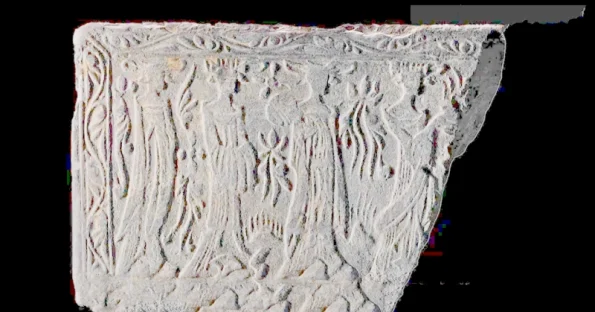
Xiāngyáng chūtǔ de Náncháo huàxiàng zhuān
Pictorial Brick from the Southern Dynasties Unearthed in Xiangyang
Discussion: What were the characteristics of Wei, Jin, Southern, and Northern Dynasties clothing amidst ethnic integration, which “followed the customs of the Han Dynasty, with loose and wide sleeves”?
1. Clothing with a Flowing Aesthetic
Han Dynasty clothing had many requirements and various styles, yet its development laid an important foundation for Chinese Hanfu culture. The attire of the Wei and Jin period inherited the customs of the Han Dynasty, but the style was even more flowing and elegant. The style of Bāoyī Bódài [宽衣博带, Bāoyī Bódài] (broad robes and wide sashes) was the popular clothing style in society. Women’s attire featured long skirts trailing the ground, wide, fluttering sleeves, and layers of decorative ribbons, showcasing an elegant and ethereal style.
The chaos of the Wei, Jin, and Southern and Northern Dynasties era led to relaxed social control and open social mores, making people unwilling to be restricted. This environment was reflected in the characteristics of people’s clothing culture. The clothing of this period was influenced by the social economy, politics, and culture of the time, presenting a natural, unrestrained, fresh, and refined temperament.
2. Innovative Development Leading to the Sui and Tang Styles
The establishment of the Sui Dynasty followed the unification of a divided China, in a Central Plains region where multiple ethnic groups had mixed for a long time. The long-term ethnic integration resulted in the borrowing of elements from minority group clothing. While Sui Dynasty clothing maintained traditional Hanfu characteristics, still primarily featuring the Rúqún [襦裙, Rúqún] (jacket and skirt), it absorbed characteristics of “Hu” (nomadic) clothing to some extent. The “Nomadic clothing for mounted archery” (Húfú Qíshè [胡服骑射, Húfú Qíshè]) is a key example of the fusion between Central Plains and minority clothing cultures, showing the importance placed on minority attire during the Sui Dynasty.
3. Tendency Towards Conservative Clothing
The clothing style of the Song Dynasty was completely opposite to that of the Tang Dynasty. Facing internal and external threats, the Song Dynasty fundamentally changed the vivid, loose, and revealing characteristics of Tang Dynasty clothing, making the style refined, simple, and reserved. Furthermore, the intellectual wave of Chéng-Zhū Lǐxué [程朱理学, Chéng-Zhū Lǐxué] (Neo-Confucianism) emerged in society, which advocated for “preserving the Heavenly Principle and eliminating human desires.” This ideological control led to the requirement for more simple clothing, making Song Dynasty attire conservative and rigorous.
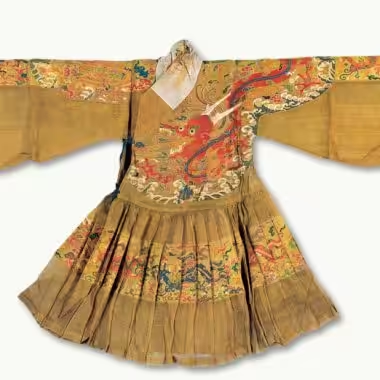
The Song and Ming Dynasties were typically influenced by the ideology of Chéng-Zhū Lǐxué. The ideological constraints of Neo-Confucianism caused various aspects of these two dynasties to become reserved and proper. The characteristic of the clothing in these two dynasties was conservation and simplicity. However, they also possessed their own cultural charm; the Míngzhì Hanfu [明制汉服, Míngzhì Hànfú] (Ming Dynasty Hanfu) has always been a symbol of richness and nobility, presenting an air of grandeur despite its simplicity.
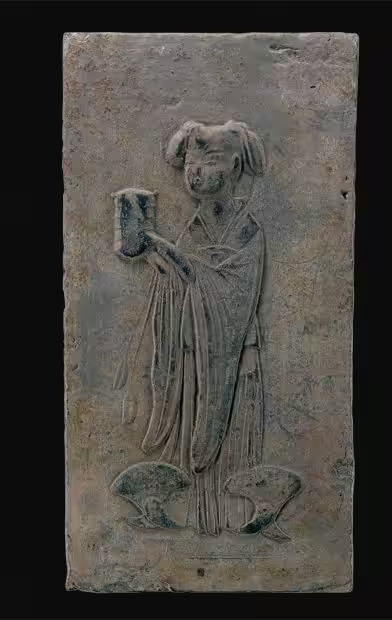
Zhōngguó Náncháo yíwù: “Pěng jià shìnǚ huàxiàng zhuān / Chí guān rén huàxiàng zhuān”, Chángzhōu shì bówùguǎn cáng
Relic of the Southern Dynasties in China: “Bridesmaid Holding a Dowry” Pictorial Brick / “Coffin Bearer” Pictorial Brick, housed in the Changzhou Museum
What are the differences in women’s clothing during the Wei, Jin, Southern, and Northern Dynasties?
Southern Dynasties clothing mostly descended from the Eastern Jin, while Northern Dynasties clothing integrated with “Hu” (nomadic) styles, giving it a more minority ethnic feel. Overall, however, the differences were not vast.
The unearthed artifacts from the Wei, Jin, Southern, and Northern Dynasties show that everyone preferred to wear relatively loose outer robes, often paired with an inner garment similar to a tank top. Traditional Hanfu typically includes a Zhōngyī [中衣, Zhōngyī] (inner garment), but because many people during the Wei, Jin, Southern, and Northern Dynasties were from minority ethnic groups, they did not have the custom of wearing a Zhōngyī.
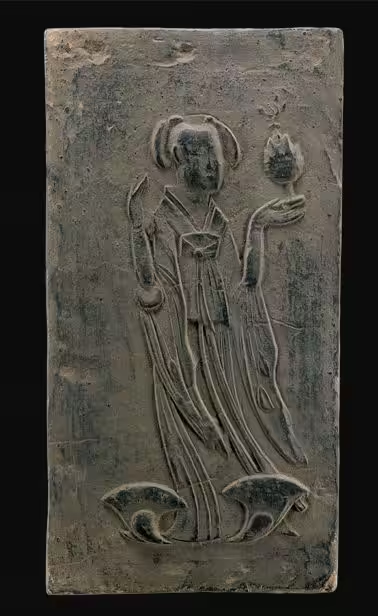
Zhōngguó Náncháo wénwù: “Tuō Bóshān lú shìnǚ huàxiàng zhuān”
Cultural Relic of the Southern Dynasties in China: “Maid Holding a Boshan Incense Burner” Pictorial Brick
The clothing of this period was also influenced by the attire of northern nomadic peoples, with many men in the Central Plains also wearing the jackets and trousers of the Northern Dynasties. Because the southern climate was relatively hot and humid, many people also wore Mùjī [木屐, Mùjī] (wooden clogs). Although the clothing of the Wei, Jin, Southern, and Northern Dynasties was not extremely elaborate, it was very comfortable. This was because people highly valued the philosophies of Zhuangzi (Taoism) and Buddhism during this time, and the clothing styles fully reflected the influence of these two schools of thought on daily life.