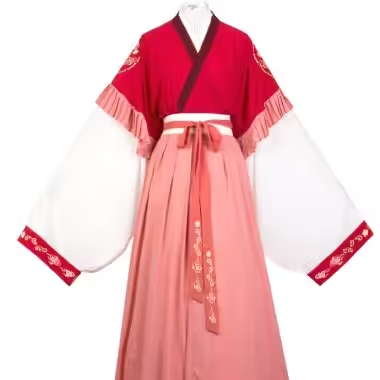
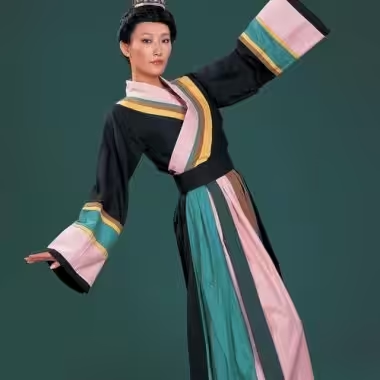
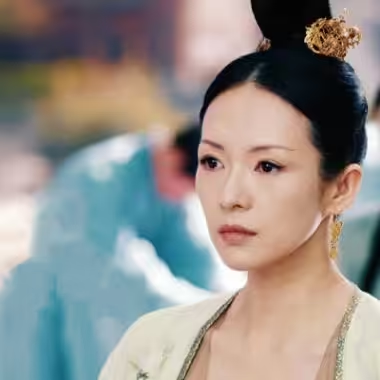
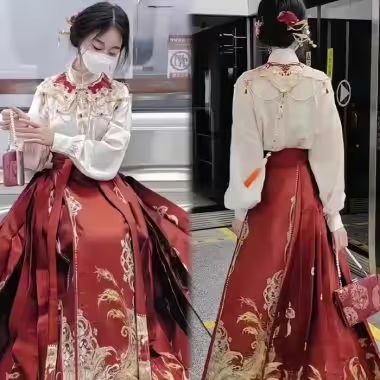
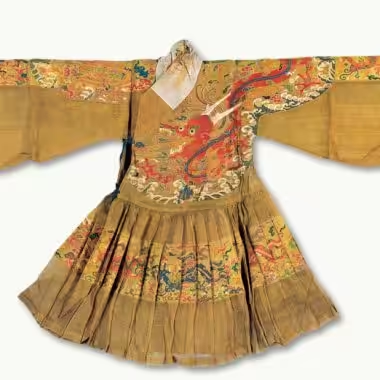
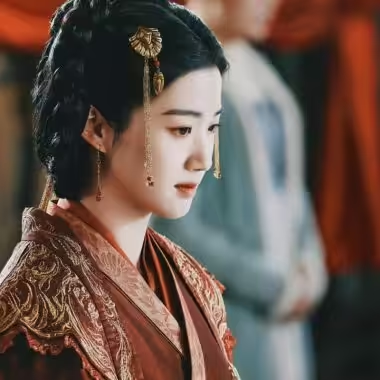
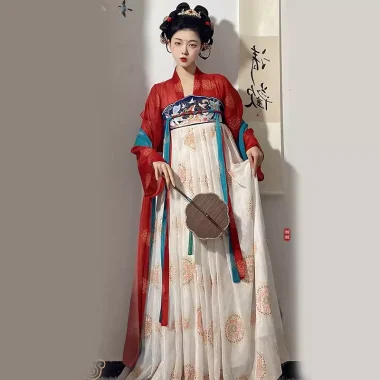
Tang Dynasty clothing (Tang Dynasty Hanfu) represents a synthesis of classical Chinese aesthetics, blending the rigorous patterns of the Zhou Dynasty, the expansive grandeur of the Warring States period, the sprightly vitality of the Han Dynasty, and the ethereal elegance of the Wei-Jin period. This fusion resulted in garments that were notably more opulent and refined than those of preceding eras, establishing a peak in ancient Chinese attire both in terms of design and ornamentation.
The fashion evolution during the Tang Dynasty (618–907 AD) can be summarized in three phases:
- Early Tang: Characterized by a natural and fresh aesthetic.
- High Tang (Sheng Tang): Defined by opulent, grand, and lavish styles.
- Mid-to-Late Tang: Known for its dazzling and sometimes peculiar designs.
A defining feature of Tang Dynasty fashion was its openness to foreign influences. It incorporated elements from the “Hu” attire—especially the clothing of the northwestern Xianbei people and styles from Central Asian states—and integrated them with traditional Hua Xia (Han Chinese) garments, forging distinctive new styles.
The primary ensemble for Tang Dynasty men consisted of the Yuanling Paoshan (round-collar robe), Futu (turban/headwear), Gedai (leather belt), and Changyao Zaogexue (tall black leather boots). While Tang women’s clothing displayed considerable variety, men’s fashion was comparatively more standardized.
Traditional ritual robes (Guanmian Yishang) were reserved for solemn occasions like sacrifices to Heaven, Earth, and the ancestral temple. For all other affairs, the Futu and Paoshan ensemble was the prevailing fashion.
The Official Color-Coding System
The color of an official’s robe was strictly dictated by their rank, a system detailed in historical texts such as Tang Liudian (Six Statutes of Tang) and the edicts recorded in Quan Tang Wen.
| Official Rank | Robe Color (Chinese Term) | Decoration |
| Third Rank and above | Purple (紫/Zǐ) | Jade (玉/Yù) |
| Fifth Rank and above | Scarlet/Crimson (朱/Zhū or 緋/Fēi) | Gold (金/Jīn) |
| Sixth and Seventh Rank | Green (綠/Lǜ) | Silver (銀/Yín) |
| Eighth and Ninth Rank | Cyan/Blue (青/Qīng) |
Brass (鍮石/Tōushí)
|
Lower-ranking, unclassified officials (Liúwài Guān) and commoners (Shùrén) were generally permitted to wear Yellow or White, decorated with copper or iron. However, fearing confusion with the imperial yellow, Emperor Gaozong later generally prohibited commoners from wearing any shade of yellow in 668 AD.
Key Components of Tang Men’s Attire
Headwear: The Futu (幞头)
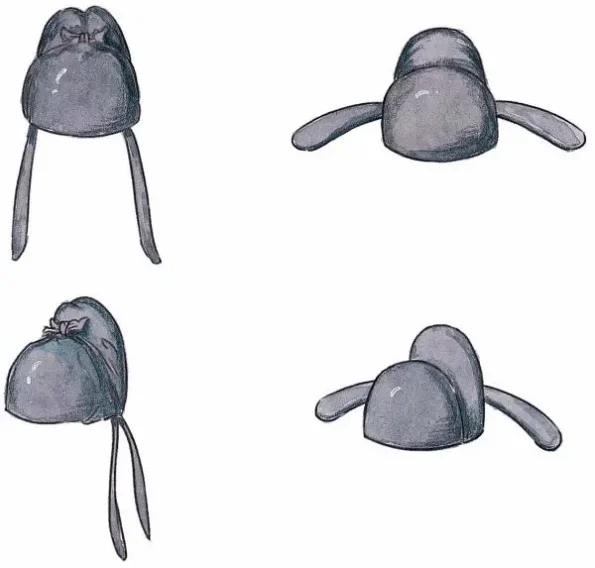
The Futu (fútóu), a black gauze or silk cloth wrapped around the hair, was the most ubiquitous head covering for Tang men. Originally a simple soft cloth (Zheshang Jin), it evolved in the Tang Dynasty. To achieve a rigid, fixed shape, inner supports called Jinzi (thin, hard frames made of wood, rattan, or leather) were incorporated.
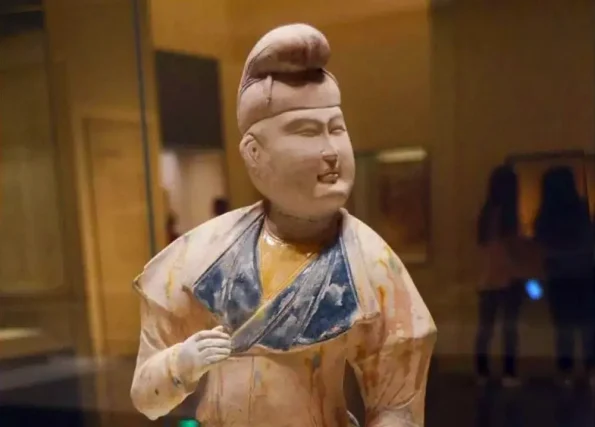
The style of the Futu evolved significantly over the centuries, resulting in distinct categories:
- Pingtou Xiaoyang (平头小样): Known as the “Flat-Top Small Style,” this was popular in the early Tang. It featured a low, flat top.
- Wujia Zhuzangyang (武家诸王样): The “Wu Family Princely Style,” said to have been created by Empress Wu Zetian. This style featured a noticeably higher cap body with a pronounced central dip.
- Yingwang Buyang (英王踣样): The “Prince Ying’s Bent Style,” introduced during the reign of Emperor Zhongzong. This cap was even taller than the Wujia style and often featured a forward or sideward lean, sometimes described as having two bulbous lobes on top.
- Guanyang Jinzi (官样巾子): The “Official Style Cap,” which emerged during the Kaiyuan era. This cap was tall, lacked the forward lean of the Yingwang style, and often featured a slightly pointed top.
Upper Garments
Tang men’s clothing featured five primary types of upper garments: Pao, Ru, Shan, Ao, and Banbi.
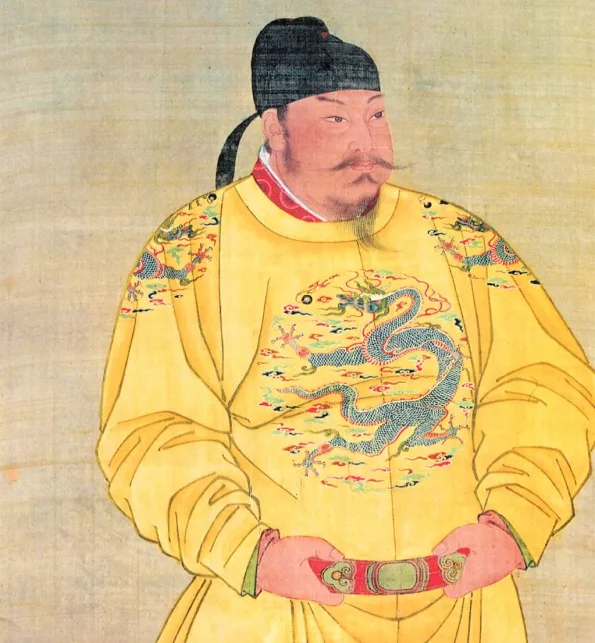
1. Pao (袍 – Robe)
- Bo Sleeve Wide Robe (博袖宽袍): Characterized by wide sleeves and a loose cut, aligning with traditional Hanfu. Primarily used for formal and ceremonial dress. Styles included the Straight-Collar Opposite-Front Robe (worn by the Emperor and high officials for court) and the Crossed-Collar Right-Front Robe (worn by both officials and commoners).
- Narrow Sleeve Robe (窄袖袍): A practical style influenced by Hu (Western/Nomadic) fashion and worn for daily activities.
- Round-Collar Robe (圆领袍/Yuanling Pao): This became the most widely adopted garment in the Tang Dynasty, worn by all social strata and both genders. The Emperor’s Dragon Robe, as seen in historical portraits, was often a variation of this narrow-sleeved, round-collar design.
- Lapel Robe (翻领袍/Fanling Pao): Originated from the Uyghurs (Huihe), this robe with an external lapel collar became a popular style due to close cultural and economic exchange.
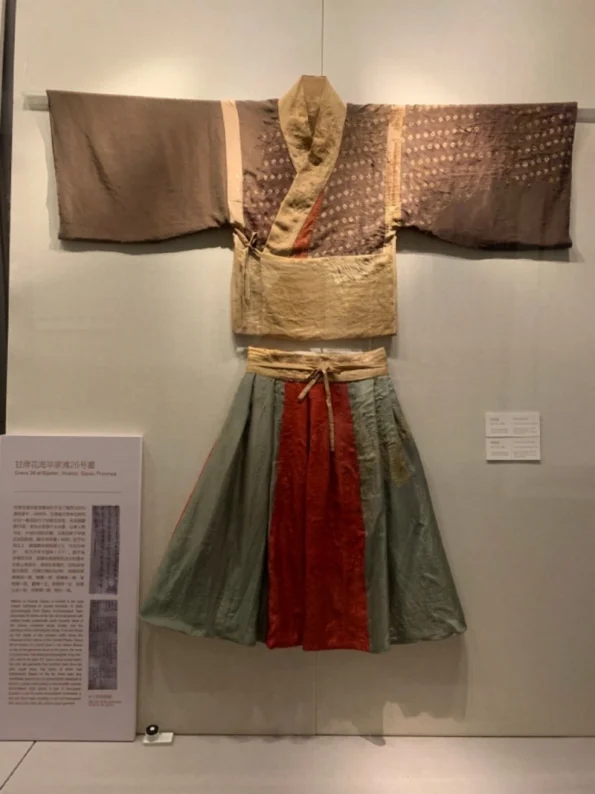
2. Ru (襦)
Defined as a short jacket that extends no further than the knee. Its compact body and narrow sleeves were designed for practicality and paired with trousers (Ku) or skirts (Shang).
3. Shan (衫 – Shirt)
- Lanshan (襕衫): A formal scholar’s gown reserved specifically for the gentry and officials, distinguished by a border/hem (lán) near the bottom.
- Quekushan (缺胯衫): A practical, side-slit shirt. The slits facilitated easy movement, making it the preferred garment for commoners, laborers, and soldiers.
4. Ao (袄 – Jacket)
An evolution of the Ru, the Ao was a jacket with an inner lining.
- Long Ao: Served as informal, casual home wear.
- Short Ao: A short, lined jacket often worn with Ku (trousers) for riding or military activities, prioritizing mobility.
5. Banbi (半臂)
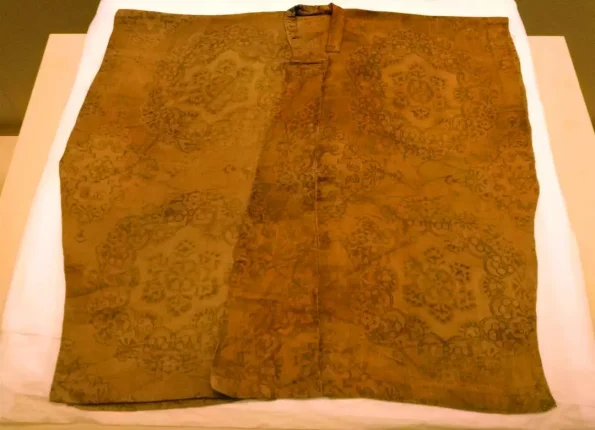
Meaning “half-sleeve,” the Banbi was a waist-length jacket that could be worn as an inner or outer layer, similar to a modern doublet or vest. It was initially a ceremonial garment, but was redesigned in the Tang to have shortened sleeves for better convenience, becoming the standard daily work attire for the laboring populace.
Lower Garments
Tang men’s lower garments primarily consisted of Shang and Kuzhe.
- Shang (裳 – Skirt): Historically referring to the garment covering the lower body, Shang functioned primarily as a component of ritual or ceremonial dress for men in the Tang Dynasty, similar to a ceremonial skirt. Daily wear was uncommon.
- Kuzhe (袴褶 – Trousers): Originally leg coverings (similar to long stockings), the Kuzhe evolved into trousers with a crotch for ease of riding. Due to its flexibility and convenience, the Kuzhe became the common everyday garment for all classes—from the emperor for riding to the common people for labor.
Summary and Conclusion
The study of Tang Dynasty fashion reveals a sophisticated system of dress that was both aesthetically rich and deeply rooted in social structure. Key characteristics include:
- Synthesis and Innovation: Tang clothing blended traditional Chinese styles with foreign influences (especially the Hu-style round-collar robe), creating a unique and diverse fashion landscape.
- Social Hierarchy: The use of specific colors (Purple, Scarlet, Green, Blue) was a rigid tool for visually enforcing the official rank and class system.
- Practicality and Variety: While ceremonial robes adhered to ancient forms, daily wear featured practical, narrow-sleeved garments like the Yuanling Paoshan and flexible items like the Kuzhe (trousers) and Banbi (vest), demonstrating a focus on mobility alongside grandeur.
At Hanfu Way, we are committed to honoring the detailed research and cultural significance of historical Chinese attire like that of the Tang Dynasty. We carefully translate these historical styles, from the elegant drape of a wide-sleeved Pao to the subtle details of a Yuanling collar, into meticulously crafted modern Hanfu garments. Explore our collection today and bring the majestic spirit of the Tang era into your wardrobe with authenticity and style.