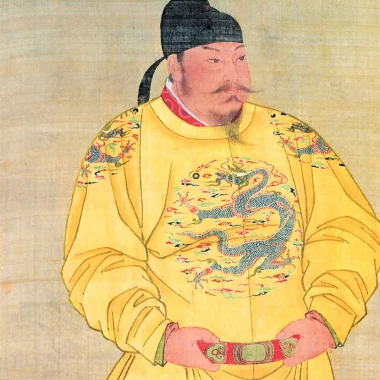
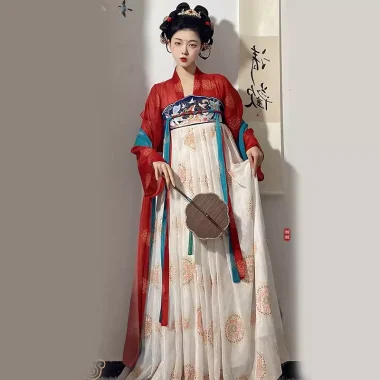
If there is one aesthetic trend that has recently swept through our daily lives, it is undoubtedly the “New Chinese Style” (新中式).
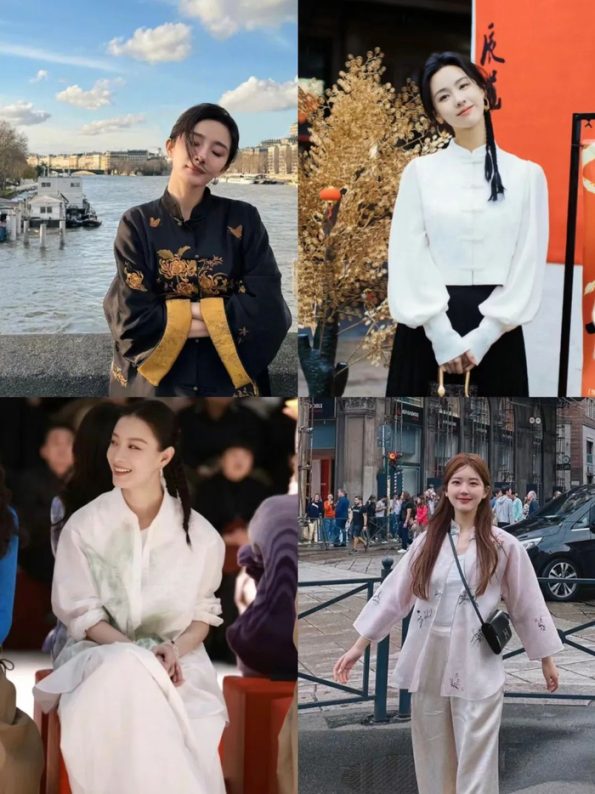
This style has permeated various domains: celebrities have adopted it as their formal “attire” on red carpets and runways; fashion bloggers widely review and recommend it on social platforms; and many people wear it for photo opportunities at popular scenic spots.
Defining the “New Chinese Style”
Defining the “New Chinese Style”
The “New” aspect of the “New Chinese Style” is relative to traditional Hanfu (汉服). Unlike Hanfu, which strictly adheres to specific historical forms, the “New Chinese Style” offers greater flexibility and freedom in its overall design. Any clothing that combines traditional elements with contemporary aesthetic trends can be classified as “New Chinese Style” attire.
Examples include: a Chinese-style jacket with frog fasteners (pan-kou) paired with a mamian skirt(Ma Mian Qun/马面裙); a Chinese shirt paired with linen wide-leg pants; or a Qipao complemented by a coiled hairstyle, woven frog fasteners, or elegant, classical embroidery.
The style’s vigorous popularity stems from the profound heritage of traditional Chinese aesthetics. Details, from patterns and color palettes to buttons and stitching, serve as small epitomes of six millennia of cultural inheritance. Netizens have affectionately dubbed it the “Chinese Old Money Style.”
The influence of the “New Chinese Style” extends beyond fashion to areas such as home decor, beverage and dining services, beauty, and general lifestyle, constantly innovating the modern expression of Oriental aesthetics.
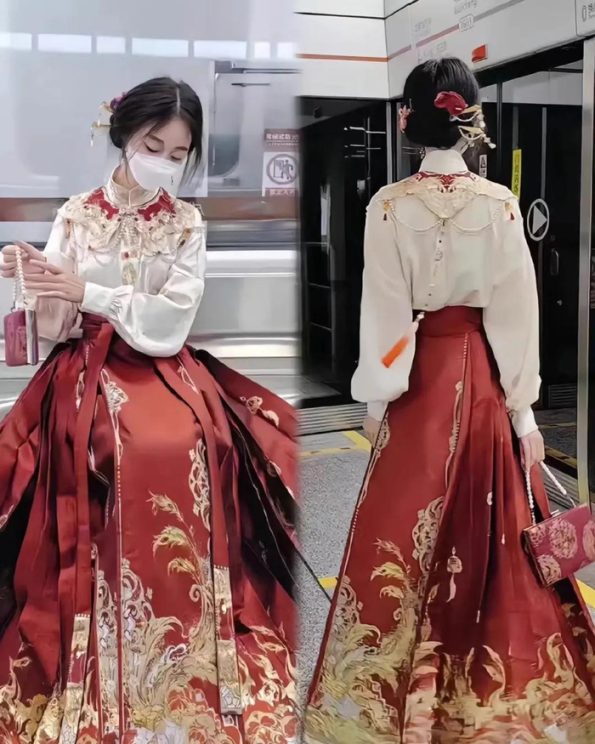
Gaun wajah kuda
The Correct English Terminology
In English, “New Chinese Style” is correctly expressed as “Neo-Chinese Style.”
While both “Neo-” and “New” convey the meaning of “new” in English, they have subtle differences in usage:
- “Neo-“ is typically used as a prefix to denote “new,” but it often implies the “copying or imitation” of a preceding phenomenon—a style of revival or renaissance. For example, “neoclassical architecture” refers to a style that copies or revives ancient Greek and Roman architecture.
- “New” generally signifies a new content that is distinct from the original theory or object, often representing an “update” following a deliberate theoretical or structural “break.”
This distinction is evident in philosophical terminology. For instance, scholars have used “new” and “neo-” to differentiate between Song-Ming Neo-Confucianism and Contemporary Neo-Confucianism since the 20th century:
- Song-Ming Confucianism, which aimed to reconnect with Confucian thought after a millennia-long interruption by Buddhism and Taoism, is translated as Neo-Confucianism.
- Contemporary Confucianism since the 20th century is translated as New Confucianism.
(Note: “neo” is a constitutive component and not a standalone word, and therefore should not be used directly to modify a noun.)